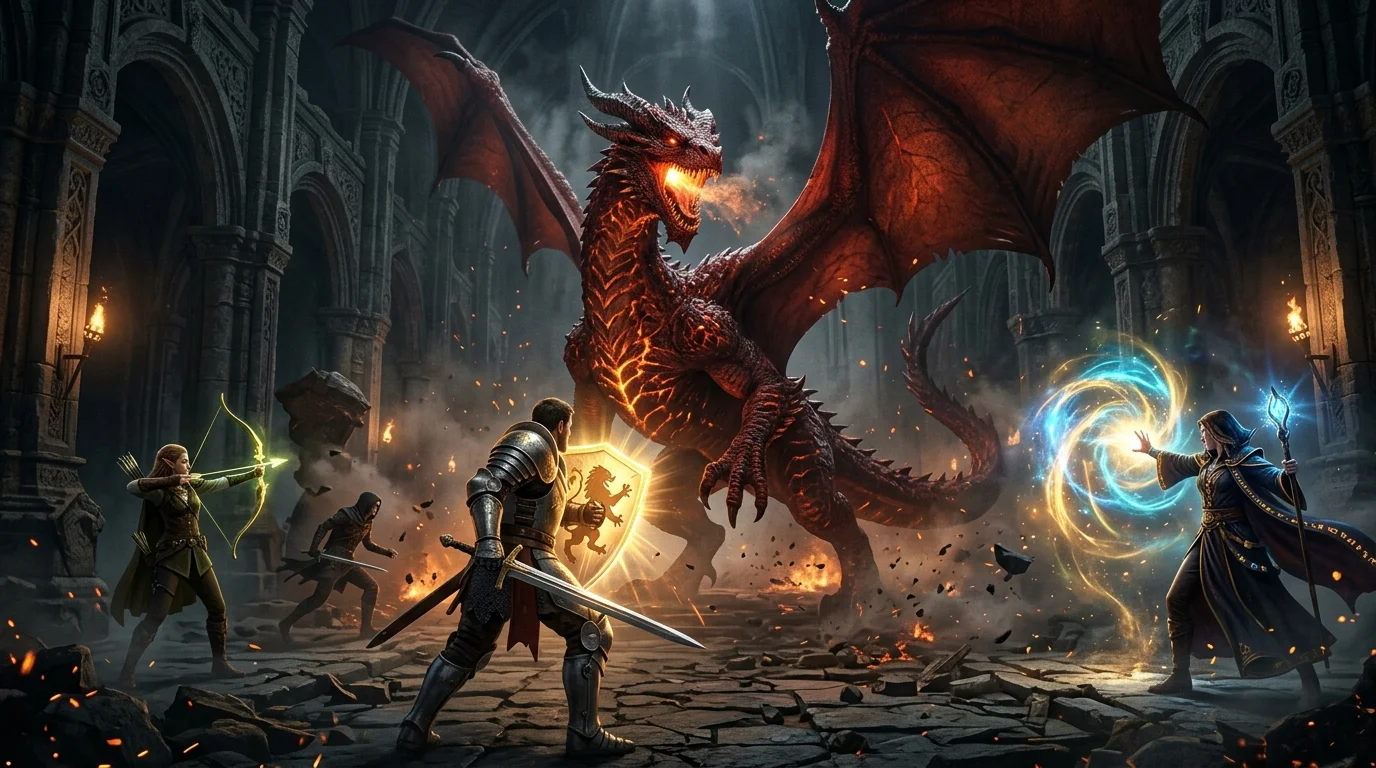
Action economy in D&D 5e refers to the total number of actions, bonus actions, and reactions a side can take per round. Because four players command four actions against a single monster, solo bosses suffer mathematically unless augmented by minions, legendary actions, or crowd control effects.
In Fifth Edition Dungeons and Dragons, action economy represents the single most influential mathematical factor deciding combat encounters. Even high-tier monsters with formidable Armor Class and massive hit point pools quickly succumb to four or five mid-level adventurers if the creature can only act once per combat round.
The Fundamental Mathematics of Turns
Every combatant in a standard round operates with an action, bonus action, reaction, and movement speed. When four player characters face a solitary creature, the adventuring party commands four main actions and four potential reactions against the lone enemy. If three players focus on offensive damage while the fourth readies crowd control, the party inflicts overwhelming cumulative damage before the monster acts a second time.
For this reason, solo monsters frequently feel underwhelming in practical play. An adult dragon possessing a challenge rating of ten wields immense damage potential, but four level six characters casting spells and making extra attacks can dismantle three hundred hit points in three rounds. Understanding turn generation transforms encounter design from guesswork into a balanced tactical challenge.
Balancing Combat with Minions and Legendary Actions
To counterbalance party action dominance without creating mathematically lethal damage spikes, effective Dungeon Masters employ two primary design techniques:
- Minions and Bodyguards: Introducing three to six low-challenge creatures (such as goblins, cultists, or animated skeletons) splits player focus. Instead of concentrating four attacks on the boss, players must commit actions and spell slots to eliminate peripheral threats.
- Legendary and Lair Actions: Legendary actions allow prominent boss monsters to act at the end of other combatants' turns. By moving without provoking opportunity attacks, making single melee strikes, or casting minor cantrips, the boss spreads damage evenly throughout the round.
Tracking complex encounters with multiple monster tiers and condition timers requires clear visual organization. Digital aids such as the Combat and Initiative Tracker streamline turn order and monitor active conditions so table momentum never stalls. For physical tabletop sessions, pairing digital tracking with tactile curated combat condition rings keeps status effects immediately legible for every player at the board.
Optimizing Player Action Efficiency
Players maximize their tactical effectiveness by eliminating wasted actions:
- Weaponize Bonus Actions: Classes like rogues, bards, and clerics leverage bonus actions for Cunning Action, Bardic Inspiration, and Spiritual Weapon, doubling their round output.
- Strategic Reactions: Retain reactions for high-impact triggers such as Shield, Counterspell, or sentinel attacks rather than minor situational parries.
- Proactive Crowd Control: Applying conditions like Stunned, Restrained, or Incapacitated removes enemy turns entirely, multiplying your party's net action advantage.
By calibrating monster numbers with an Encounter Difficulty Calculator and respecting action mathematics, Dungeon Masters deliver memorable, dynamic boss encounters that challenge players without relying on artificial hit point inflation.
Featured Tactical Gear: Condition Rings & Markers
Keep turns moving quickly at the table with durable, color-coded 5e status condition markers designed for 28mm miniatures.
Related 5e Utilities